

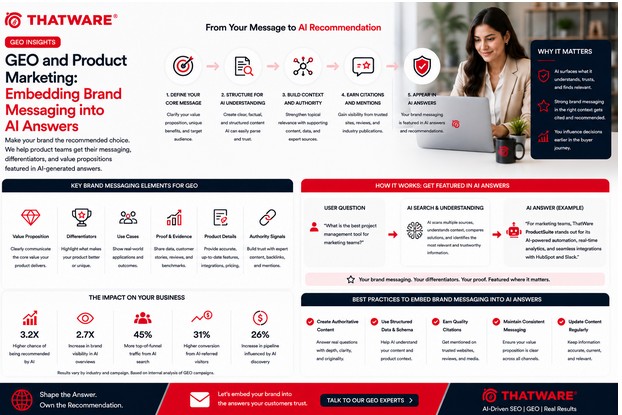
Product marketers spend a lot of time on positioning. Getting the messaging right — the specific language that captures what your product does, who it’s for, and why it’s meaningfully different — is one of the most consequential and difficult things a product marketing team does.
The problem: that carefully crafted positioning often doesn’t make it into AI-generated answers about your category. The AI has its own version of who you are, built from the aggregate of everything it’s found on the web about your brand — which may or may not align with how you’d describe yourself. And increasingly, that AI-generated characterization is what buyers encounter during research, before they ever see your own messaging.
This is the product marketing GEO challenge. And it’s one that product marketers are uniquely well-positioned to address, if they understand where the leverage points are.
How AI Systems Form Brand Characterizations
When a buyer asks an AI tool “what is [Your Brand] and what is it good for,” the AI isn’t reading your positioning document. It’s synthesizing characterizations from your website, your review profiles, your press coverage, your customer testimonials, your comparison content, forum discussions, analyst reports — the whole ecosystem of text that mentions your brand.
If that ecosystem consistently reflects your intended positioning, the AI’s characterization will be fairly close to how you’d describe yourself. If it’s inconsistent — if your website says one thing, your G2 reviews emphasize different features, your press coverage focuses on an older product line, and forum discussions describe use cases you’ve moved away from — the AI will construct something that doesn’t quite match any of these, usually defaulting to whatever signals are strongest and most repeated.
This means brand messaging consistency isn’t just a marketing discipline anymore. It’s an AI citation optimization requirement.
The Positioning Alignment Audit
A useful starting exercise for product marketing teams: run your key positioning claims through the major AI tools as queries. If you position yourselves as “the easiest enterprise data integration platform,” ask ChatGPT and Perplexity “which enterprise data integration platform is easiest to use” and see whether you appear — and if so, whether the characterization matches your claim.
The gaps you find are your GEO product marketing roadmap. Maybe the AI associates you with ease-of-use but doesn’t mention “enterprise” — suggesting your mid-market heritage is still dominant in available training data. Maybe you’re not cited at all for your key differentiators — suggesting competitors have built better citation infrastructure around those specific claims.
This kind of audit takes a few hours and produces more actionable intelligence than many expensive research projects.
Embedding Messaging Through Content Architecture
The most direct way to ensure your positioning shows up in AI answers is to produce content that makes that positioning specific, verifiable, and repeatedly stated in accessible formats.
This is different from just writing your positioning on your homepage. AI systems extract specific claims when they appear in authoritative, well-structured content with verifiable support. “The most intuitive interface in enterprise software” is a claim an AI will likely ignore. “Based on SoftwareReviews’ 2025 Enterprise UX Report, [Brand] received the highest usability score in the data integration category for the third consecutive year” is a claim an AI can reference with confidence.
Best GEO agency for thought leadership work in the product marketing context often involves translating positioning statements into evidence-backed content that AI systems can extract and cite. The positioning doesn’t change — the evidential infrastructure supporting it does.
Category Creation and AI Citation
Some product marketing teams are doing category creation work — positioning their product as the defining example of an entirely new category. This is ambitious, and it’s particularly challenging in a GEO context.
AI systems lag category creation. If the category name you’re using doesn’t appear with any significant frequency in the text AI systems have been trained on, the system won’t know how to use it — and may actually translate your category name back into an established category it does recognize, undermining the positioning work.
Category creation in AI-driven search environments requires an unusual volume of external reference building. Your category name needs to appear in external publications, analyst reports, and community discussions — not just your own content — before AI systems will treat it as established enough to cite. The timeline for this is longer than traditional category creation, and the effort is different in character (more external amplification, less control over the specific language used).
Review Content as Positioning Infrastructure
Product marketers should think about review platforms — G2, Capterra, TrustRadius — as positioning infrastructure, not just social proof. The language customers use in reviews, when it consistently reflects core positioning elements, becomes part of the citation ecosystem that AI systems draw from.
This doesn’t mean manufacturing or manipulating reviews. It means making it easy for customers to articulate what they love about your product in terms that reflect your positioning, through review prompt questions, customer success conversations that surface specific value elements, and case studies that highlight your key differentiators in customer language.
When customers consistently describe your product in specific, positioning-aligned terms across review platforms, AI systems encounter that language repeatedly and incorporate it into their characterizations.
Competitive Positioning in AI Answers
How your brand is characterized in comparison queries — “X vs. Y,” “alternatives to Z” — is a significant product marketing concern in an AI-driven search world. These comparison queries drive significant buyer behavior, and how you show up in them can be as important as how you show up in pure category queries.
GEO agency for ChatGPT and Perplexity optimization specifically around comparison queries involves ensuring that the specific claims you want associated with your brand in competitive contexts are well-supported in accessible, credible sources. Your competitive differentiators need external validation — customer quotes, data, analyst recognition — not just internal assertion.
Comparison content you publish yourself (honest, well-structured comparison guides) also contributes, but external validation carries more weight in AI-generated comparison answers than owned content.
The Ongoing Nature of Positioning Maintenance
Product marketing positioning evolves. Products change. Markets shift. Competitive dynamics evolve. Traditional positioning maintenance — updating the website, retraining sales teams, updating pitch decks — is hard enough.
In a GEO world, positioning maintenance also requires ensuring that the evolving positioning is reflected in the external citation ecosystem, not just your owned properties. Old positioning language can persist in AI answers long after you’ve moved away from it, because the AI is drawing on accumulated text data that includes your old materials.
This isn’t an argument against evolving your positioning — it’s an argument for systematic external amplification of updated positioning, treating the citation ecosystem as a channel that requires deliberate maintenance alongside your owned properties.
Product marketing has always been about making the right positioning legible to the right audiences. AI answers are now a critical channel for that positioning. The product marketers who understand this will shape how AI systems characterize their products in buyer research.